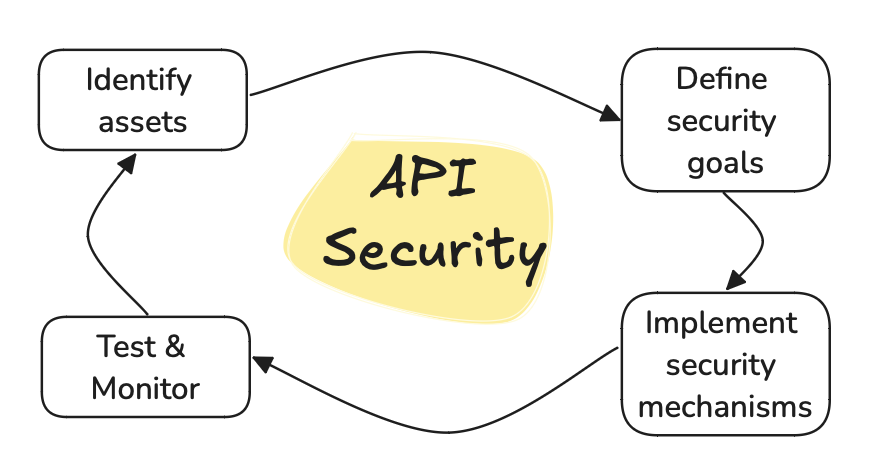
Designing a secure API means thinking through more than the happy path. You need to know what you’re protecting, what “protected” means in practice, and which mechanisms actually get you there.
This article covers the most common security mechanisms, input validation, and authentication.
Key security considerations
Identifying assets
APIs typically manage sensitive data: customer information, payment details, database contents. The first step is knowing exactly what you’re protecting.
Defining security goals
Security goals define what “protecting your assets” actually means in practice.
The “CIA Triad” is a well-known framework used to establish these goals:
- Confidentiality: Ensures that information is accessible only to the intended audience.
- Integrity: Prevents unauthorized creation, modification, or destruction of information.
- Availability: Ensures that legitimate users can access the API when needed, without being hindered.
Implementing security mechanisms
Security mechanisms counter specific threats, tailored to the environment the API runs in. It’s much cheaper to build security in during development than to fix it after something breaks in production.
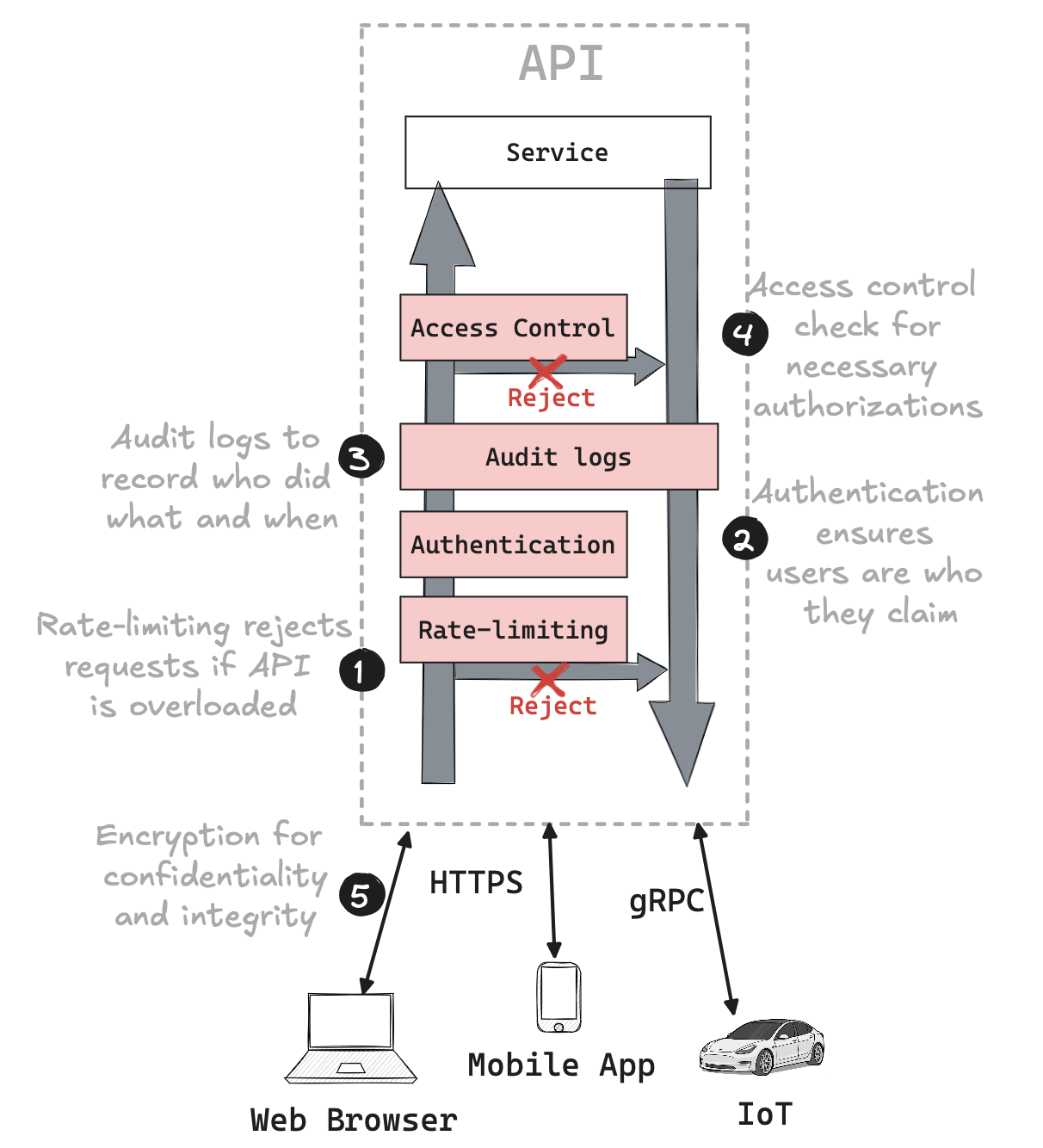
The core mechanisms for any well-designed API:
- Encryption: Protects data from being read by unauthorized parties, both in transit and at rest. Modern encryption also ensures that data cannot be tampered with by attackers.
- Authentication: Verifies that users and clients are who they claim to be.
- Access Control (Authorization): Ensures that every request to the API is properly authorized.
- Audit Logging: Records all operations to provide accountability and enable proper monitoring.
- Rate-Limiting: Prevents any single user or group from monopolizing resources, ensuring fair access for all legitimate users and ensuring availability.
Developing secure REST APIs
REST APIs work well across web and cloud environments, but they introduce specific security considerations worth addressing early. Here’s what matters most.
Preventing injection attacks
Injection attacks happen when unvalidated user input gets incorporated directly into dynamic commands or queries, letting attackers control what gets executed.
To prevent this:
- Prepared Statements: Use APIs that support prepared statements, where user inputs are clearly separated from dynamic code. This ensures that the database cannot mistake user input for executable code.
- Permissions: Limit database permissions to prevent unauthorized actions. For example, if your API doesn’t need to delete tables, don’t grant it that permission. This reduces the potential impact of an SQL injection attack.
Security flaws often arise when attackers submit inputs that violate code assumptions. To mitigate this:
- Input Validation: Define acceptable inputs using well-established formats and libraries. An allow list, specifying valid inputs, is more secure than a blocklist, which tries to exclude invalid ones.
- Safe Output: Ensure that all API outputs are well-formed and cannot be exploited. Apply standard HTTP security headers to all responses and double-check error responses.
Rate-limiting for availability
Rate-limiting is your main defense against DoS attacks. Apply limits to all requests, especially unauthenticated ones, to prevent your servers from being overwhelmed by excessive traffic.
This should be the first security measure applied when processing a request.
Authentication to prevent spoofing
Authentication tells you who is performing an operation. Without it, audit logging and access control don’t function correctly.
HTTP Basic authentication, a widely used method, involves sending credentials in a standard HTTP header.
Web browsers have built-in support for HTTP Basic authentication as does curl and many other command-line tools.
This allows you to send a username and password to the API, but you need to securely store and validate that password.
A better approach is to outsource authentication using a federation protocol like SAML or OpenID Connect, or an LDAP directory. This offloads credential management to systems purpose-built for it.
Using HTTPS
HTTPS encrypts data in transit and verifies the server’s identity through certificate validation. Without it, passwords and tokens can be intercepted in transit.
Audit logging for accountability
Every action performed through your API should be recorded in an audit log.
These logs should be sent to a centralized Security Information and Event Management (SIEM) system for analysis, helping detect potential threats and unusual behavior.
Implementing access control
Authentication identifies who a user is; access control determines what they can do.
An access control list (ACL) specifies which users can access specific objects and defines the permissions for each user.
Avoiding privilege escalation
Restrict the ability to grant permissions. New users shouldn’t receive more permissions than whoever added them, or limit permission-granting entirely to users who already hold full permissions.
Securing gRPC APIs
gRPC is an open source RPC framework built for high-performance service-to-service communication, common in microservices architectures. It uses Protocol Buffers instead of JSON, which changes some security considerations compared to REST.
Key recommendations:
- Use Mutual TLS (mTLS): Encrypts data in transit and authenticates both the client and the server, not just the server.
- Use streaming carefully: If using gRPC streaming, enforce flow limits to avoid resource exhaustion and keep data handling secure.
- Control service exposure: Only expose the services and methods that need to be external. Keep internal services internal.
- Enable logging and monitoring: Track access patterns and flag anomalies to facilitate auditing of gRPC calls.
Everything from the REST section applies here too: authentication, authorization, input validation, and rate-limiting.
Conclusion
API security isn’t one thing you implement and check off. It starts with knowing what you’re protecting, setting clear security goals, and applying the right mechanisms. Input validation, rate-limiting, authentication, and access control address most common threats. Get those right before worrying about anything more exotic.
The Security Lab Newsletter
This post is the article. The newsletter is the lab.
Subscribers get what doesn't fit in a post: the full attack code with annotated results, the measurement methodology behind the numbers, and the week's thread — where I work through a technique or incident across several days of testing rather than a single draft. The RAG poisoning work, the MCP CVE analysis, the red-teaming patterns — all of it started as a newsletter thread before it became a post. One email per week. No sponsored content. Unsubscribe any time.
Join the lab — it's free Already subscribed? Browse the back-issues →